

For retailers and brands, the pandemic thrust e-commerce into centre stage. Overnight, online presence became table stakes for retailers and brands, who scrambled to stand up online capabilities which could make up for their loss of physical sales.
Five years on, physical stores are back open, but e-commerce remains a critical channel and source of competitive advantage. The same retailers and brands are investing heavily to ensure their online stores, stood up in such haste, are underpinned by strong systems and processes, and prepared to create data-driven, personalised consumer experiences which are consistent across the online and offline worlds.
This dynamic has created opportunities for software and service providers supporting the digital commerce ecosystem, and a similar opportunity for investors. This article takes a brief look at three areas of opportunity where Fairgrove has recent experience.
Fig. 1: UK E-Commerce Share of Retail Sales
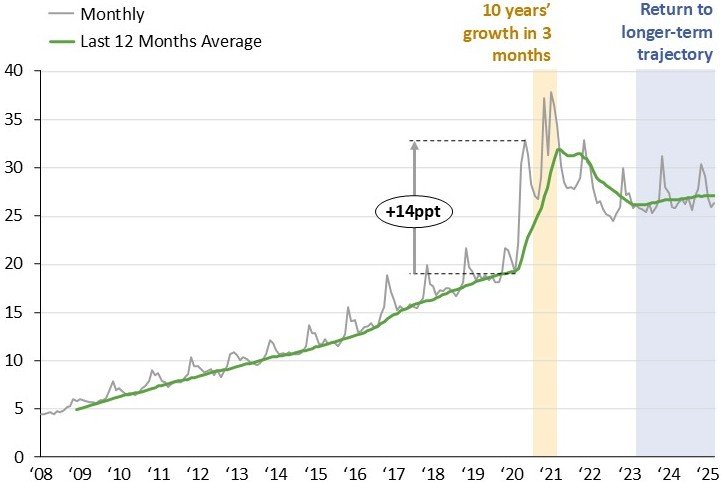
UNITS: Percent; SOURCE: ONS, Fairgrove Analysis
Fig. 2: SME Omnichannel Strategy
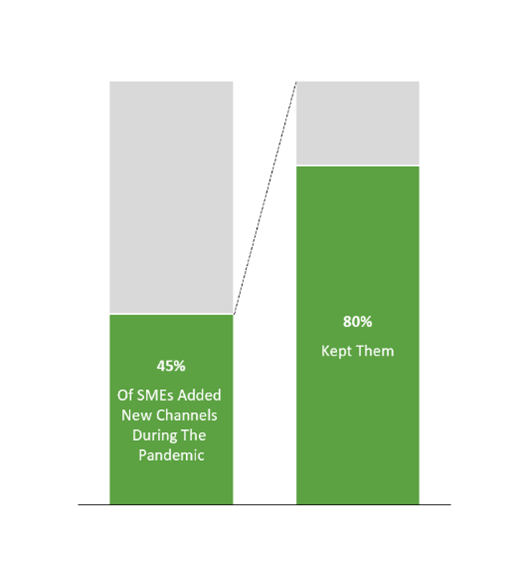
UNITS: Percent of Respondents; SOURCE: The Atlantic
1. Price Optimisation Software
– Dynamic pricing software allows retailers to dynamically manage and adjust prices, by applying rules and elasticity models to data collated from internal sources (including product metadata, stock levels, margins, price history) and competitor price monitoring.
– The software is a crucial ally for major retailers in sectors like fashion, health, cosmetics, home decor, electronics, and sporting goods (where products are easily identifiable, comparable, and relatively homogeneous), with further applications in B2B retail and service industries.
– The industry is growing quickly, and consolidating, and represents an exciting opportunity for investors.
Fairgrove credential: Fairgrove advised Copilot Capital on its investment in retail dynamic pricing software PriceShape. You can find further information in our article here: Smart Money: Maximising Returns with Price Optimisation Software in Retail.
2. Digital Commerce Agencies
– At the core of any retailer or brand’s online presence is a digital commerce platform (of which Salesforce Commerce Cloud and Shopify Plus are among the most prominent). Subsequently, there is a significant opportunity for agencies which help retailers implement and optimise these platforms.
– The digital commerce agency market is growing healthily: within B2C and D2C retail, the next wave of major platform upgrades is being driven by a trend towards headless and composable technologies; within B2B verticals such as manufacturing, automotive and logistics, the market is significantly less mature, but following similar trends.
– Beyond platform implementations, agencies frequently generate upwards of 50% of revenue from recurring, non-implementation services such as solution monitoring, roadmap delivery and technical support.
– For investors, the digital commerce agency market represents an attractive prospect for buy-and-build: strategic acquisitions can be used to add capabilities with new commerce platforms (e.g. BigCommerce, Commercetools), in adjacent software (e.g. product information management or order management software), or to expand overseas to serve global brands.
Fairgrove credential: Fairgrove advised management and WestBridge on the buyout of digital commerce agency Tryzens, and subsequent bolt-on of Shopify Plus specialist Juno Retail.
3. “Product Experience Management (PXM)”
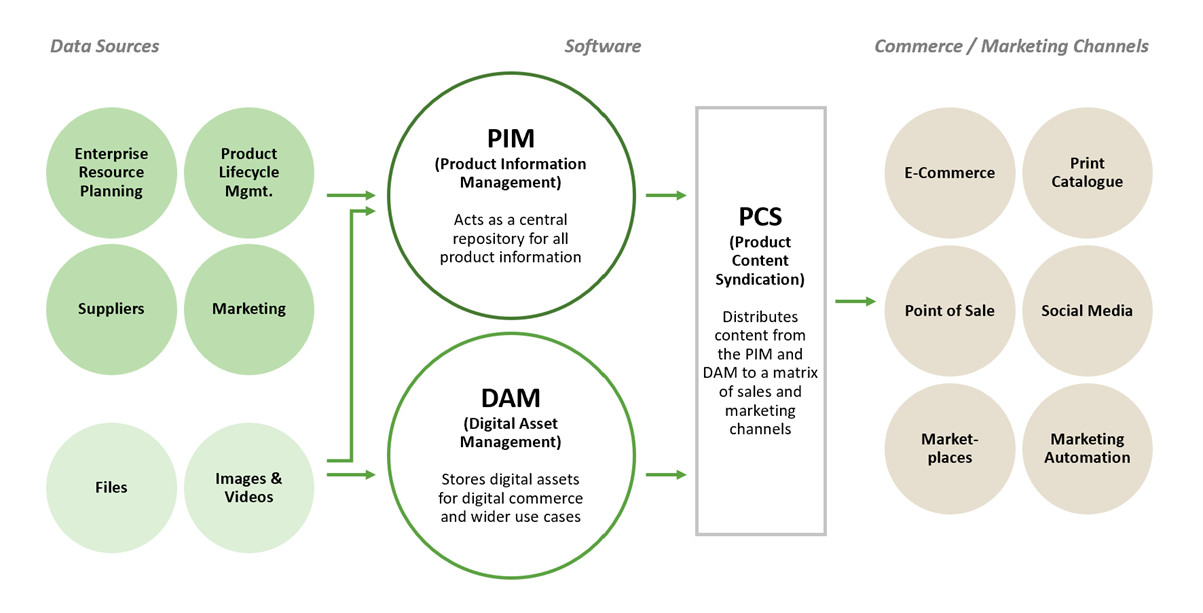
Fig. 3: PXM Software Overview
SOURCE: Fairgrove Research & Analysis
– At the heart of creating consistent consumer experiences is joined up systems, processes, and data. Product Information Management (PIM), Digital Asset Management (DAM), and Product Content Syndication (PCS, which might also be called channel integration / feed management) are examples of software designed to help with precisely that.
- PIM: a central repository for all product information (including product descriptions, specifications, shipping requirements, metadata), which collates data from various sources (including supplier data and internal ERP and OMS transaction data) and distributes it to external sites (including point-of-sale systems and e-commerce sites).
- DAM: similar to a PIM, but specifically catering to the management of digital assets (such as images, videos, PDFs and audio files). Most PIM solutions have DAM capabilities in-built, allowing rich media to complement product information, however digital assets also have use cases beyond product information (e.g. company logos, supplier documents, marketing videos), and therefore frequently justify a standalone solution.
- PCS: solutions which manage the distribution of product information from the PIM and DAM to the digital shelf. This process can be highly complex when a retailer has thousands of SKUs and lists its products in multiple languages on various digital stores, marketplaces and social channels. Different sites require product information to be supplied in precise (but different) formats – formats which are frequently changing – and PCS solutions ensure the process is automated and consistent.
– PIM, DAM and PCS are increasingly enabling retailers to deliver seamless, personalised experiences across a growing number of channels, nevertheless there remains significant headroom for growth in adoption (particularly among SME and mid-market retailers, and B2B sellers). AI has the potential to further reinforce the return on investment in these solutions – for example, AI can auto-generate product descriptions and enable intelligent search of digital asset databases.
– As investments by retailers and brands in the data and processes underpinning digital commerce sites catch up with the investments they have made in their storefronts, a host of opportunities exist for private equity.
Fairgrove credential: Fairgrove advised NorthEdge Capital on its investment in ICP (a global marketing services provider specialising in content management, creative operations, and the digital shelf) and Mercia Asset Management on its investment in Pimberly (product information management software for digital commerce).
Contact Us
If you would like to learn more about Fairgrove’s experience in the space or discuss this article and any of the themes covered within it, please reach out to Paddy Woods Ballard or Jolyon Dannatt.


